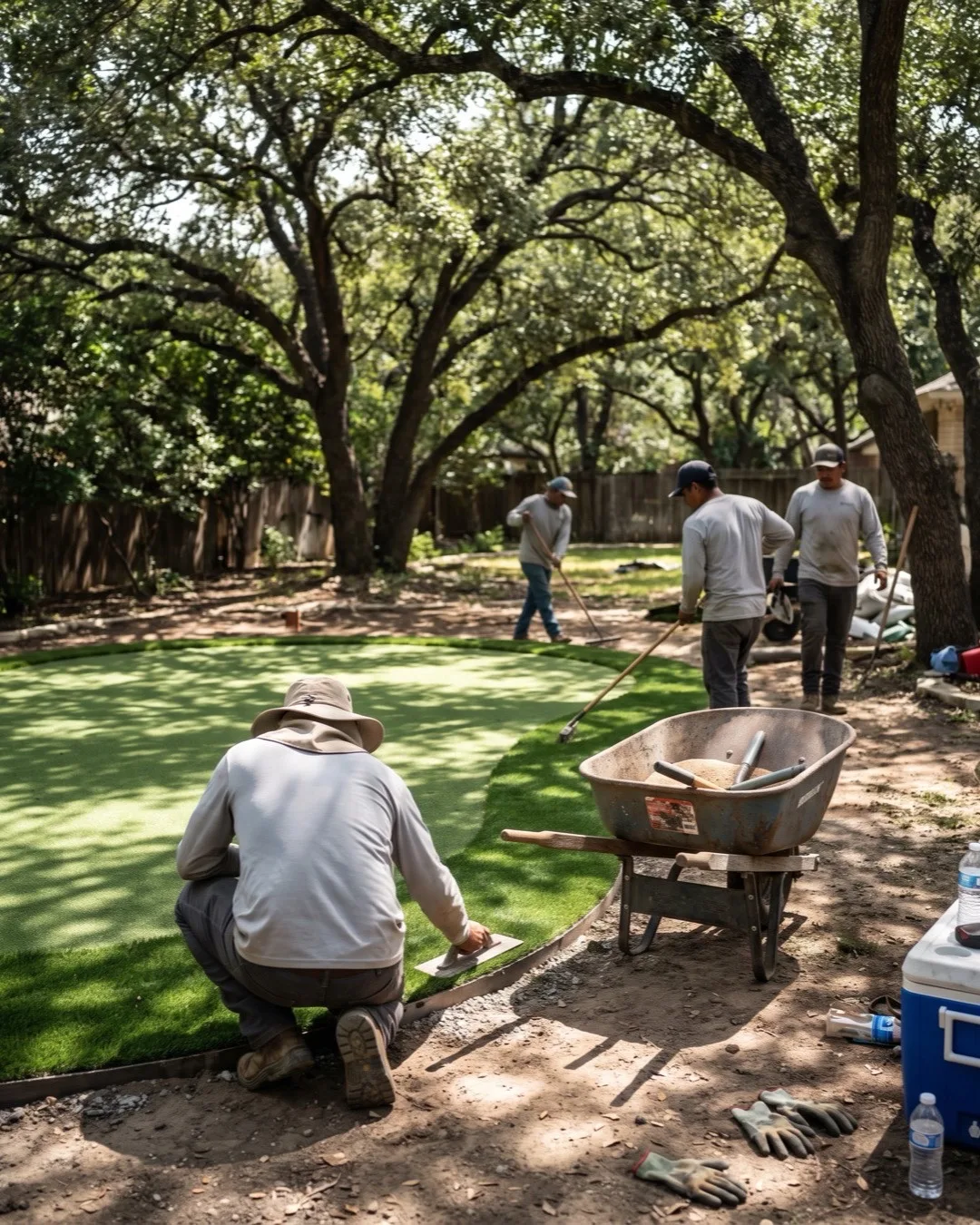
Lubbock Artificial Turf designs and installs backyard putting greens, practice greens with real cups, fringe collars, and break you choose, built to a far tighter tolerance than any lawn. A lawn hides a small dip under a soft pile. A green shows it to you on every putt, which is why greens are the most exacting job in synthetic turf.
Two Lubbock facts decide how a backyard green gets built. First, bermuda goes dormant after the first freeze, which arrives around November 11, and does not fully green up again until late March or April, so a natural practice green is tan for roughly five months of the year while a synthetic one putts the same in February. Second, this is the tenth-windiest city in the United States, averaging 12.4 miles per hour, so a green here gets built with a heavier sand load and a fastened perimeter, because wind that lifts an edge will find the same edge every day after that.
The build is different from grass turf top to bottom: a short, dense putting pile instead of a tall lawn fiber, a heavier sand fill rolled into the surface to set speed, and a base finished dead-flat except where you want the ball to move. Done right, the ball rolls out the same line every time, which is the entire point of practicing on it.
The base under a green is screeded and rolled to a tolerance a lawn never needs, because every surface flaw becomes a ball deflection. Contours and break are shaped deliberately in the base, never left over from sloppy grading.
Putting pile, not lawn fiber
Greens use a short, dense pile, typically nylon or a dense polypropylene around half an inch, that holds a heavy sand fill. That's what lets the surface take a rolled-in speed and hold receptive enough to accept a chip.
Speed set to your number
Green speed is measured with a Stimpmeter and tuned by infill level and rolling. Want it to putt like your club's greens or faster? Say so at the design stage, speed is a spec, not an accident.
Cups, fringe, and layout you design
We cut regulation cups where the design calls for them, ring the green with a taller fringe collar for chipping lies, and lay out target lines, tiers, or a chipping pad off the side if the space allows.
Backyard greens come in four common layouts. The build precision is the same at any size; the design decides what you can practice.
Backyard Practice Putting Greens
The standard backyard green is built for reps: a few hundred square feet, two to four cups, and enough break to keep it interesting. Enough green to groove a stroke every evening.
Chipping Pads & Short-Game Setups
A green plus fringe plus a chipping pad, so wedge work from real lies is part of the session. The taller fringe collar gives you rough-style lies to play from.
Small Corner Greens for Tight Yards
Small corner greens fit yards that can't give up the whole lawn, and they still hold real practice value. Two cups and one breaking putt beat an empty patch of grass.
Putting Green & Turf Lawn Combos
A green pairs naturally with a lawn install: putting pile in one zone and landscape turf around it, one base build, one crew visit, two surfaces.
The five steps are the same as any install, what changes is the precision at steps two and three.
1
Design and layout
Green shape, cup count and positions, break direction, fringe width, and target speed all get settled on paper before anything is dug. Design decisions made here are cheap; made later they are not.
2
Excavation and precision base
The base is compacted in lifts like any job, then screeded and rolled to putting tolerance, with contours shaped in exactly where the design wants break.
3
Putting surface and fringe
The putting pile is laid, seamed invisibly, and trimmed; the taller fringe collar goes in around it for chipping lies and a clean visual edge.
4
Cups cut and set
Regulation cups are cut and set flush, a proud or sunken lip announces itself on every holed putt, so flush is non-negotiable.
5
Sand fill, rolling, and speed check
Heavy sand fill is broomed in and rolled in stages until the surface stimps where you asked, and the green gets putted before it's called done.
How Much Does a Putting Green Cost in Lubbock?
Greens are the premium tier on our homepage cost table: about $15 to $40 per installed square foot in the national guides, with a 500-square-foot green typically landing between $7,500 and $20,000. The precision base work, the specialty pile, and the shaping hours are what separate that range from lawn pricing.
Within the range, size and complexity drive the number: more contour, more cups, more fringe, and tiered designs all add build time. A simple flat practice green sits at the low end. The design conversation and the quote are free.
As fast as you ask for, within the surface's range. Speed is set by infill level and rolling and measured with a Stimpmeter, and it's tunable after install, more fill and rolling speeds it up. Say what your course putts like when you ask for a quote, green speed is a spec worth naming up front.
Will it hold a chip shot?
A sand-filled putting surface accepts a properly struck chip with a hop and release, much like a firm green. It won't spin back like a soft tour green, no synthetic surface will, but short-game practice on it translates.
How much space do I need?
Useful practice greens start around a couple hundred square feet, enough for two cups and a breaking putt. Bigger unlocks longer putts and more cup positions, but a well-designed small green beats an empty corner of lawn every time.
What maintenance does a green need?
Blow off leaves, keep the surface clean, and expect the sand fill to need occasional topping and rolling to hold speed. There's no mowing, watering, or hole-moving, the cups stay where you cut them unless you add more later.
Can a putting green be built on a sloped yard?
Yes, with more base work. A green needs to sit level except for the break you design in, so a sloped yard gets cut and built into a level pad first, sometimes with a low retaining edge on the downhill side. That adds excavation to the job, which is exactly the kind of thing worth settling before anyone quotes a number.
A green putts best when the yard around it matches — many green projects start or finish with a full artificial lawn.
Get a Free Putting Green Quote in Lubbock
Describe the space and how you want it to play. You get a call back to talk design and price, and the quote costs nothing.